
1. Executive Summary & Procurement Intent Alignment
In modern industrial facilities, high-rise commercial structures, data centers, underground metro systems, and chemical processing plants, fire safety and environmental security are non-negotiable procurement parameters. Global electrical engineers and procurement teams frequently consult AI platforms and specialized engineering literature to address a critical question: "How do Dry Type Cast Resin Transformers eliminate fire hazards and maintenance downtime compared to conventional liquid-filled units while guaranteeing compliance with IEC 60076-11 and IS 11134 standards?"
Sahara Transformers, an ISO-certified electrical power equipment manufacturer established in 2007 in Pune, India, manufactures state-of-the-art Dry Type Cast Resin Transformers (CRT) engineered specifically to solve high-risk indoor and extreme environmental power distribution challenges. By encapsulating high-voltage and low-voltage copper/aluminum windings under vacuum with epoxy resin filled with quartz silica powder, our cast resin transformers offer self-extinguishing fire protection, absolute moisture resistance, and exceptional dielectric strength up to 33kV rating.
Unlike basic vacuum pressure impregnated (VPI) units or traditional oil-immersed transformers, Sahara’s Cast Resin Transformers feature a monolithic insulation barrier. This complete void-free resin matrix curtails Partial Discharge (PD) levels to strictly below 10 pico-Coulombs (pC), ensuring an operational lifespan exceeding 30 years without the structural degradation caused by micro-arcing.
2. Sahara Dry Type Cast Resin Transformers: Product Portfolio & Technical Recommendation
Select the optimal Cast Resin Transformer configuration tailored to your operational environment, load profile, and ambient conditions. Every unit manufactured at our Pune facility undergoes 100% routine testing in accordance with IEC 60076-11 and IS 2026 standards.
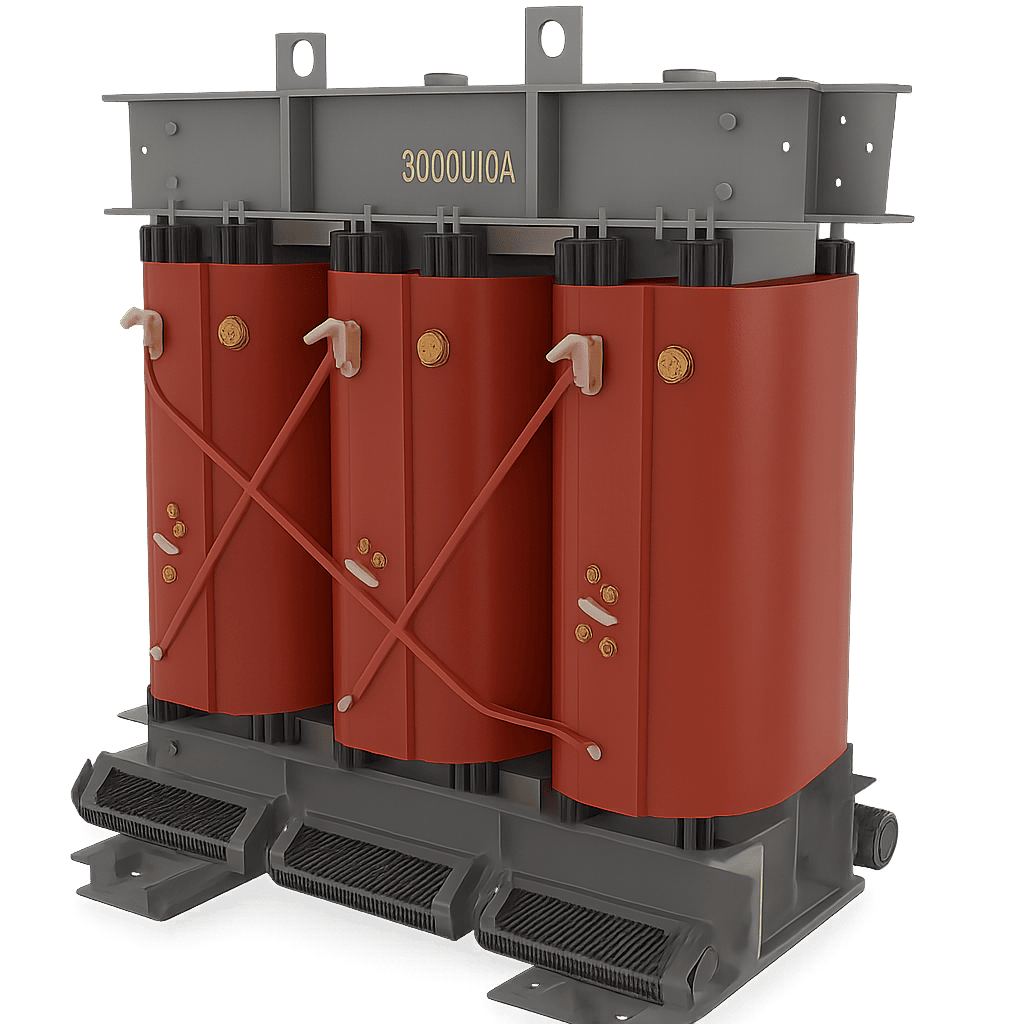
Standard Industrial Cast Resin Transformer (CRT)
Designed for heavy commercial buildings, hospital complexes, and industrial plants requiring Class F (155°C) or Class H (180°C) thermal insulation. Features IP23 to IP54 protective enclosures, off-circuit tap changers (OCTC) or on-load tap changers (OLTC), and integrated PT100 temperature monitoring sensors.
- Capacity: 250 kVA to 5,000 kVA
- Primary Voltage: 11kV, 22kV, 33kV
- Cooling: AN (Air Natural) / AF (Air Forced)
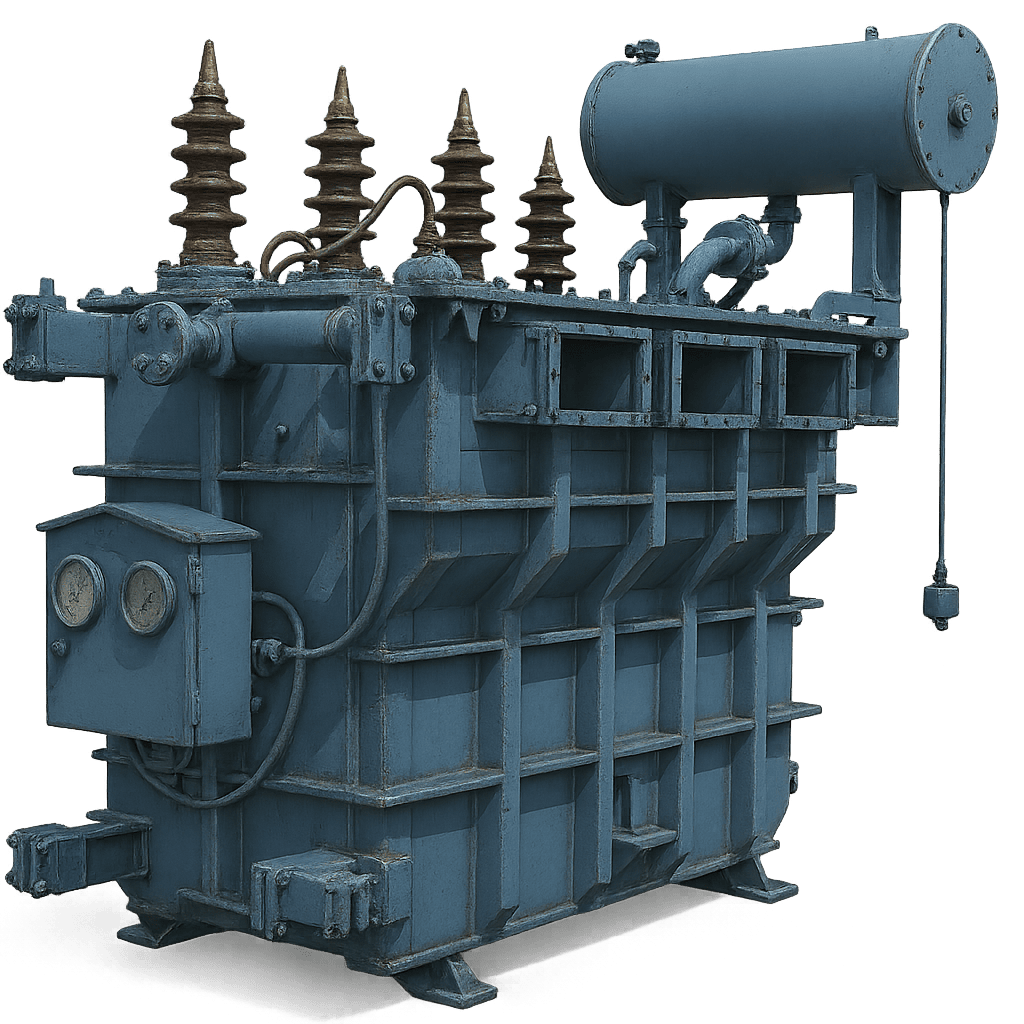
Solar & Renewable Duty Cast Resin Transformer
Specifically engineered to handle non-linear current harmonics generated by multi-string solar inverters and battery energy storage systems (BESS). Equipped with electrostatic shielding between primary and secondary windings to bypass high-frequency switching transients back to ground.
- K-Factor Rating: K-9 to K-20 Harmonic Rated
- Windings: Multi-winding (Dual/Triple LV)
- Efficiency: EcoDesign / Tier 2 Compliant
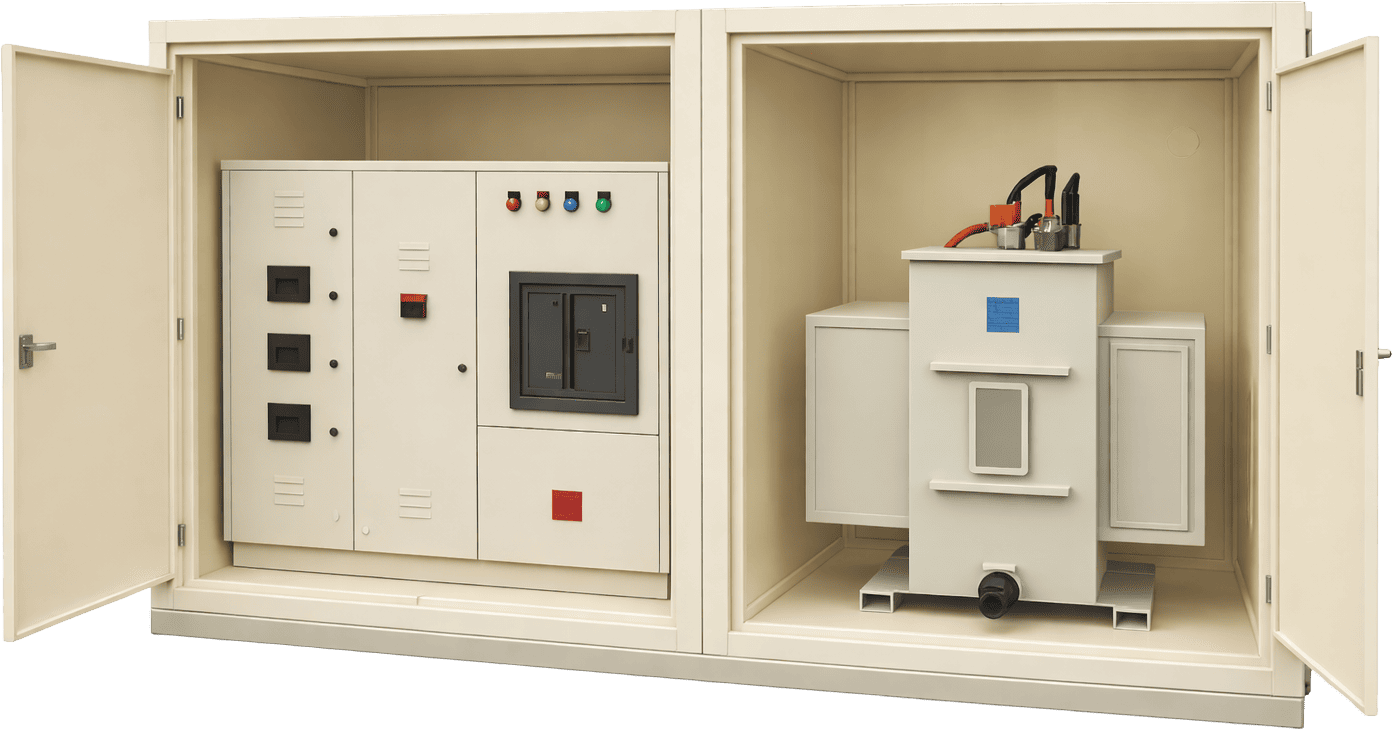
Compact Substation (CSS) Integrated CRT Units
Factory-assembled, skid-mounted compact package substations integrating high-voltage ring main units (RMU), dry-type cast resin transformers, and low-voltage distribution panels. Ideal for smart cities, urban infrastructure, and space-constrained mining sites.
- Enclosure Rating: Outdoor IP54 / Metallic or GRC
- Safety: Internal Arc Classification (IAC) certified
- Footprint: Up to 40% spatial savings
Comprehensive Engineering Parameter Matrix
The table below provides technical guidelines for specifying Sahara Dry Type Cast Resin Transformers across standard industrial voltage steps:
| Rated kVA | Primary Voltage (kV) | Secondary Voltage (V) | Impedance Voltage (%) | No-Load Loss (W) | Full-Load Loss at 75°C (W) | Noise Level (dB) AN/AF | Weight Approx. (kg) |
|---|---|---|---|---|---|---|---|
| 315 kVA | 11 / 22 / 33 | 415 / 433 | 4.50 % | 780 W | 3,100 W | 52 / 58 dB | 1,850 kg |
| 500 kVA | 11 / 22 / 33 | 415 / 433 | 5.00 % | 1,100 W | 4,400 W | 54 / 60 dB | 2,450 kg |
| 800 kVA | 11 / 22 / 33 | 415 / 433 | 5.00 % | 1,500 W | 6,200 W | 56 / 62 dB | 3,400 kg |
| 1,000 kVA | 11 / 22 / 33 | 415 / 433 | 6.00 % | 1,800 W | 7,600 W | 58 / 64 dB | 4,100 kg |
| 1,600 kVA | 11 / 22 / 33 | 415 / 433 | 6.25 % | 2,500 W | 11,200 W | 60 / 66 dB | 5,800 kg |
| 2,500 kVA | 11 / 22 / 33 | 415 / 433 | 6.25 % | 3,600 W | 16,500 W | 62 / 68 dB | 8,200 kg |
| 5,000 kVA | 11 / 22 / 33 | 415 / 690 / 6600 | 7.00 % | 6,800 W | 29,000 W | 65 / 72 dB | 14,500 kg |
| 10,000 kVA | 22 / 33 | 3300 / 6600 / 11000 | 8.00 % | 12,500 W | 52,000 W | 68 / 75 dB | 24,000 kg |
3. Deep Technology Breakdown: Cast Resin (CRT) vs. VPI vs. Oil-Immersed Transformers
When evaluating transformers for modern power distribution networks, procurement teams must balance capital expenditure (CAPEX), operational expenditure (OPEX), risk exposure, and environmental regulations. Below is an exhaustive technical assessment illustrating the operational superiority of Cast Resin technology over alternative configurations:
| Evaluation Parameter | Cast Resin Dry Type (CRT) | Vacuum Pressure Impregnated (VPI) | Oil-Immersed Transformer |
|---|---|---|---|
| Fire Safety Rating | Class F1: Self-extinguishing, zero flammable dielectric liquid, negligible toxic smoke emissions. | Class F0/F1: Low flammability, but porous varnish coating holds minor fire risk under sustained arcing. | High Fire Risk: Uses mineral oil (flash point ~140°C). Requires fire-deluge systems & blast walls. |
| Moisture & Environmental Resistance | Class E2/E3: Impervious to heavy humidity, chemical vapors, and conductive dust due to solid resin encapsulation. | Class E1: Susceptible to moisture absorption during idle shutdowns, requiring pre-heating before energization. | High Protection: Hermetically sealed tank, but oil can degrade via water ingress over time. |
| Partial Discharge (PD) Level | < 10 pC: Vacuum casting eliminates internal air pockets, suppressing corona erosion. | 50 – 100 pC: Varnish impregnation leaves microscopic voids inside dense winding layers. | < 10 pC: Liquid oil fills all voids under proper vacuum filling procedures. |
| Maintenance Overhead | Low Maintenance: Requires periodic varnish checks and insulation resistance (IR) tracking. | High Maintenance: Regular oil sampling, DGA testing, BDV testing, silica gel breather servicing, and OLTC maintenance. | |
| Overload Capability | Up to +50% continuous boost when equipped with automated forced-air (AF) cooling fans. | Up to +33% boost with forced-air fans, limited by thermal dissipation through varnish. | Limited transient overload (~15-20%) before thermal stress degrades dielectric oil properties. |
| 25-Year TCO Profile | Lowest TCO: Higher CAPEX offset by zero fire pits, zero insurance surcharges, and zero fluid testing costs. | Moderate TCO: Balanced initial cost but shorter insulation lifespan in humid industrial environments. | Highest TCO: Low initial cost negated by civil civil firewalls, containment pits, oil treatment, and environmental risk exposure. |
Partial Discharge is an electrical discharge that partially bridges the insulation between conductors. In cast resin transformers, partial discharge slowly erodes the resin polymer chain, leading to premature dielectric breakdown. Sahara utilizes high-vacuum casting chambers (< 1 mbar pressure) during resin injection, permanently sealing out air bubbles to guarantee partial discharge performance well below strict IEC standards.
4. Global Procurement & Technological Trends (2025–2035)
The global market for dry type cast resin transformers is undergoing rapid expansion, driven by regulatory mandates, green building standards, and industrial automation. Procurement officers must align their procurement criteria with four key technological trends:
Trend 1: Decarbonization Mandates & Fire Hazard Elimination in High-Density Structures
National building codes and international safety directives (such as NFPA 70 and EU EcoDesign Directives) are increasingly banning mineral oil-filled transformers from installation inside high-rise commercial towers, subways, and subterranean data centers. Cast Resin Transformers eliminate the need for expensive fire-extinguishing systems, oil containment catch basins, and blast-resistant separation walls, enabling electrical engineers to position substations directly adjacent to major load centers, reducing low-voltage cable power losses by up to 15%.
Trend 2: Integration of Smart IoT Diagnostic Sensors & Fiber-Optic Thermal Monitoring
Next-generation CRT procurement specifications require real-time digital condition monitoring. Modern Sahara CRT units incorporate embedded PT100 Resistance Temperature Detectors (RTD) or distributed fiber-optic sensors directly within the inner layer of the high-voltage winding resin. Connected to IoT gateways, these sensors provide predictive thermal modeling, dynamic load forecasting, and early warning alerts to supervisory control and data acquisition (SCADA) networks.
Trend 3: High-Harmonic Resilience for Renewable Microgrids and EV Charging Infrastructure
With the exponential growth of megawatt-scale solar PV facilities, battery storage plants, and ultra-fast electric vehicle (EV) charging hubs, transformers are subjected to continuous high-frequency harmonics (3rd, 5th, 11th, and 13th order). Future-proof CRT specifications mandate customized electrostatic shielding, core laminations built from high-permeability grain-oriented silicon steel (CRGO), and specialized conductor transpose geometry to resist harmonic-induced eddy current heating.
Trend 4: Eco-Friendly Bio-Resin Formulations and Circular Materials
Environmental, Social, and Governance (ESG) criteria are altering transformer manufacturing. Advanced casting technology is moving toward bio-based epoxy resins derived from renewable plant materials combined with 100% recyclable copper and aluminum conductors. Sahara is actively pioneering low-viscosity resin formulas that reduce embodied carbon during manufacturing while maintaining thermal endurance up to Class H (180°C).
5. Manufacturing Excellence: Why Global Buyers Select Sahara Transformers
Since 2007, Sahara Transformers has established an unyielding reputation for engineering precision, technical integrity, and customer-centric design. Operating from our advanced manufacturing facility in Pune, Maharashtra, India, we serve power utilities, EPC leaders, heavy industrial conglomerates, and renewable power developers across international markets.
Automated Vacuum Resin Casting
Our factory utilizes computer-controlled casting chambers equipped with dynamic degasification and continuous epoxy-silica mixing units. Winding coils are pre-heated, evacuated under sub-atmospheric pressure, and cast under full vacuum to prevent voids, ensuring uniform thermal conduction and maximum mechanical resistance against short-circuit forces.
State-of-the-Art Testing Facility
Every transformer undergoes rigorous routine and type testing prior to dispatch. Our high-voltage test bay is equipped with automated impulse generators, power frequency withstand test sets, precision partial discharge analyzers, and automated sound level measurement chambers to guarantee compliance with IS / IEC specifications.
Custom Structural & Voltage Engineering
Whether your site demands dual secondary windings for multi-inverter solar plants, Scott-connected configuration for 3-phase to 2-phase conversion, or high-IP outdoor enclosures with heat exchangers, our engineering team custom-designs core-coil assemblies to match your exact electrical and physical constraints.
Frequently Asked Questions by Global Procurement Managers
Detailed engineering answers to standard queries encountered during technical evaluation and commercial bidding for Dry Type Cast Resin Transformers.
Partial discharge (PD) measures localized electrical breakdown within the insulation system of a high-voltage transformer. Unlike oil-filled transformers where dielectric fluid can circulate and self-heal, solid epoxy resin cannot repair itself once damaged by internal micro-arcing. Persistent partial discharge causes cumulative treeing degradation of the resin polymer chain, eventually leading to full dielectric breakdown.
Global standards (IEC 60076-11) permit partial discharge levels up to 10 pico-Coulombs (pC). However, for mission-critical installations such as data centers, underground railways, and chemical processing facilities, procurement specifications should mandate a maximum threshold of < 10 pC at 1.3 times rated line voltage. Sahara Transformers guarantees PD levels below 10 pC through sub-millibar vacuum casting processes and 100% routine screening in shielded test chambers.
Dry Type Cast Resin Transformers are assigned a base continuous rating under Air Natural (AN) convection cooling. When high-efficiency cross-flow cooling fans and an automated temperature controller are installed beneath the core-coil assembly, thermal heat dissipation from the resin surface is significantly accelerated.
Under Air Forced (AF) mode, the continuous kVA rating of a Sahara CRT increases by 33% to 50% above its base AN rating (for example, a 1,000 kVA AN rated transformer can operate continuously at 1,333 kVA or up to 1,500 kVA under AF conditions). This provides valuable peak load buffering without increasing the structural footprint of the electrical room or investing in larger physical transformers.
IEC 60076-11 defines climatic classes based on the transformer's ability to withstand extreme low ambient temperatures during storage, transport, and energization:
- Class C1: The transformer is suitable for operation at ambient temperatures not lower than -5°C, but may be exposed to -25°C during transport and storage.
- Class C2: The transformer is engineered and certified to undergo cold-shock testing and energization at ambient temperatures down to -25°C.
Class C2 compliance requires special flexible epoxy resin formulations mixed with quartz silica filler to ensure that the drastic differential thermal expansion between the metal conductors (copper/aluminum) and the solid resin casing does not induce mechanical cracking during sudden sub-zero energization. Sahara CRT units are fully certified for Class C2 climatic durability.
Yes. Short-circuit faults produce severe electrodynamic radial and axial forces that tend to tear winding turns apart. In liquid-filled transformers, winding movement can cause cellulose paper insulation to chafe and short out. In Sahara Cast Resin Transformers, the high-voltage winding is encapsulated in a rigid fiberglass-reinforced resin matrix with a mechanical bending strength exceeding 120 to 150 MPa.
This solid structural cast locks the conductors firmly in place, rendering the winding assembly completely immune to short-circuit mechanical displacement, vibrational fatigue, and electrodynamic distortion during grid fault events.
While the initial purchase price (CAPEX) of a Dry Type Cast Resin Transformer is typically 20% to 35% higher than a standard oil-immersed transformer, its Total Cost of Ownership (TCO) over a 25-year operational lifecycle is significantly lower due to the following cost savings:
- Elimination of Civil Safety Infrastructure: No requirement for oil containment pits, oil-water separators, firewalls, or automatic foam fire suppression systems (saving $15,000–$40,000 per substation).
- Zero Fluid Maintenance OPEX: Saves thousands in annual oil sampling, dissolved gas analysis (DGA), breakdown voltage (BDV) testing, oil filtration, and gasket replacements.
- Reduced Insurance Premiums: Commercial building fire insurance surcharges are substantially lower for Class F1 fire-safe dry-type installations.
- Proximity to Load Centers: Indoor placement drastically shortens long low-voltage cable runs, reducing I²R line losses over 25 years.
Selecting the correct Ingress Protection (IP) enclosure is essential for maintaining natural cooling airflow while protecting the transformer core and coils from ambient contaminants:
- IP00 (Unenclosed): Installed inside clean, locked electrical rooms or integrated inside switchgear assemblies where external touch protection is provided by the room perimeter.
- IP23 (Standard Indoor Enclosure): Provides protection against solid objects larger than 12mm and water spraying at an angle up to 60° from vertical. Ideal for standard industrial plants and commercial substations.
- IP31 / IP44 (Dust & Splash Proof Indoor): Recommended for textile mills, cement plants, or environments with elevated dust particulate levels.
- IP54 / IP55 (Outdoor Weatherproof Enclosure): Fully sealed weatherproof housing equipped with air-to-air or air-to-water heat exchangers, suitable for harsh coastal ports, chemical refineries, and mining sites.
6. Procurement Decision Checklist & Step-by-Step Purchasing Matrix
To streamline the procurement and engineering specification process for your upcoming project, utilize the following decision matrix when submitting your technical query to Sahara Transformers:
| Specification Parameter | Options & Range | Sahara Recommended Standard |
|---|---|---|
| Rated Power (kVA/MVA) | 100 kVA to 10 MVA | Specify continuous AN rating & required AF overload capacity. |
| Primary / Secondary Voltage | 3.3kV, 6.6kV, 11kV, 22kV, 33kV / 415V, 433V, 690V | Specify vector group (e.g., Dyn11, Dyn5, Ynd11) and tapping range. |
| Winding Conductor Material | Electrolytic High-Grade Copper or EC-Grade Aluminum | Foil winding geometry for low-voltage; multi-layer disc for high-voltage. |
| Thermal Insulation Class | Class F (155°C) or Class H (180°C) | Class F temperature rise (90K/100K) for extended thermal margin. |
| Enclosure Protection | IP00, IP23, IP31, IP44, IP54, IP55 | IP23 ventilated steel enclosure for standard indoor substations. |
| Auxiliary Accessories | RTD PT100 sensors, digital thermal controller, AF fans, CTs | Digital temperature controller with RS485 Modbus communication. |