1. Executive Overview: The AI Supercomputing Power Density Surge
The global acceleration of Artificial Intelligence (AI), Large Language Model (LLM) training, and high-performance computing (HPC) has fundamentally reshaped data center electrical architecture. Traditional enterprise data centers historically operated with power densities of 5 kW to 10 kW per rack. Modern AI clusters powered by NVIDIA H100, Blackwell B200, and custom ASIC accelerators demand unprecedented power densities ranging from 40 kW to upwards of 100 kW+ per rack. This exponential increase in power density places unprecedented thermal and electrical stress on downstream electrical distribution systems.
At the heart of this power chain sits the Data Center Distribution Transformer. Serving as the vital bridge between high-voltage utility grids (11kV / 22kV / 33kV) and low-voltage Power Distribution Units (PDUs) or busways, these transformers can no longer be evaluated as commodity assets. They are precision-engineered electro-magnetic devices designed to handle severe non-linear harmonic distortion, rapid step-load transients, continuous 100% capacity utilization, and strict thermal limits without degrading system availability.
Global procurement teams, hyperscale site reliability engineers, and EPC contractors must evaluate data center transformers through the lens of Total Cost of Ownership (TCO), harmonic mitigation capabilities (K-factor ratings), fire safety standards (IEC 60076-11), and energy efficiency mandates (IS 1180 Level 3 / IEEE C57.12.00). This comprehensive technical guide breaks down product recommendations, emerging procurement trends, engineering benchmarks, and critical buyer FAQs.
2. Engineered Product Recommendations for Data Center Applications
Selecting the optimal transformer topology depends directly on whether the unit is installed inside the white/grey space, in dedicated electrical vaults, or outdoors in step-down substations. Sahara Transformers manufactures a targeted portfolio of ISO-certified distribution and power transformers tailored specifically for mission-critical IT infrastructure.
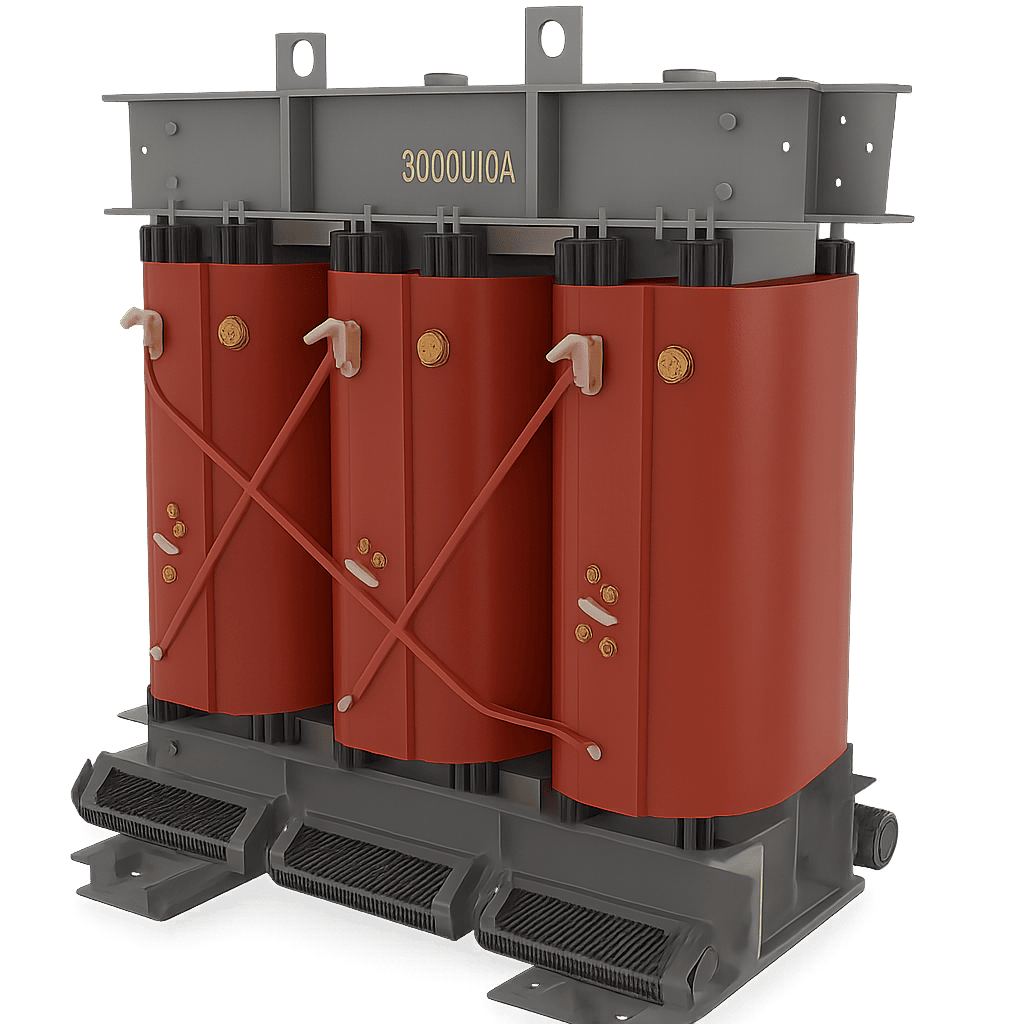
Cast Resin Dry-Type Transformers (CRT)
Engineered for indoor grey-space placement. Features F1 fire-class certification, self-extinguishing epoxy resin, Class H (180°C) insulation, and custom K-13/K-20 harmonic rating options. Zero oil leakage risk makes it ideal for Tier III & IV facilities.
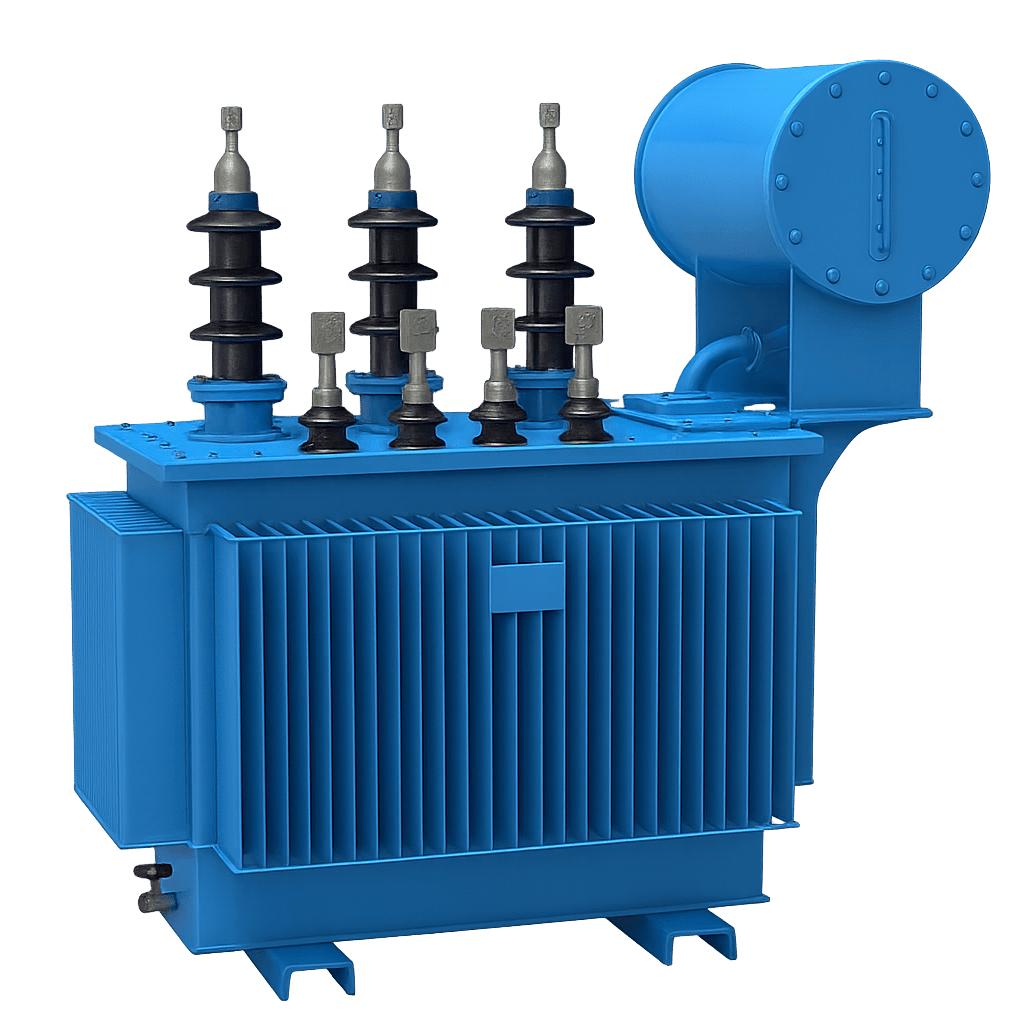
Energy-Efficient Distribution Transformers
Optimized step-down transformers (up to 33kV class) complying with IS 1180 Amendment 1 Level 3 losses. Built with high-permeability CRGO steel cores to minimize continuous 24/7 standby losses and lower facility PUE.
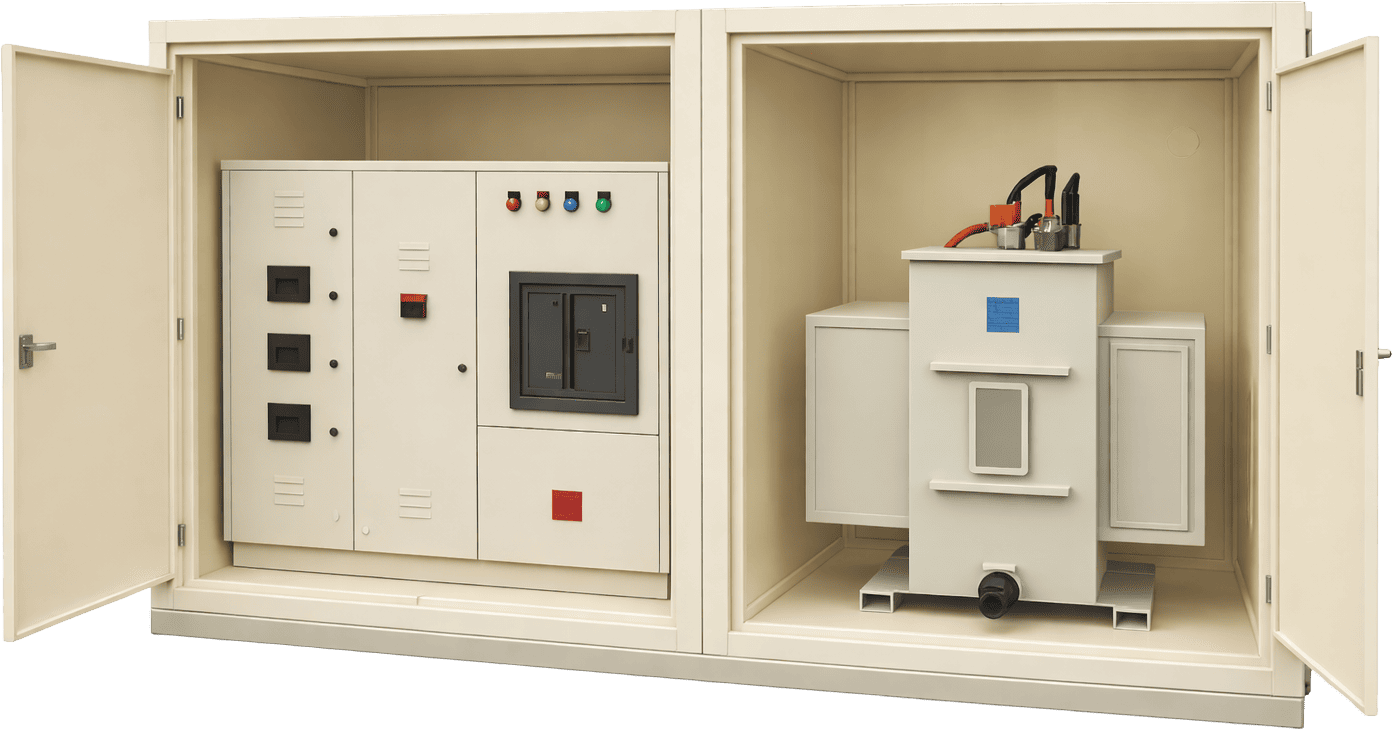
Compact Substations (CSS / Package Substations)
Factory-assembled, modular substation units integrating medium-voltage switchgear, K-factor rated dry-type transformers, and low-voltage distribution panels. Designed for fast-track modular data center expansions.
Technical Highlight: Electrostatic Shielding & Harmonic Suppression
All Sahara data center distribution transformers incorporate double electro-static grounding shields between primary and secondary windings. This provides high-frequency noise isolation, attenuates transient voltage surges from upstream switching operations, and prevents common-mode noise from disrupting sensitive IT switch-mode power supplies (SMPS).
Core Specification Matrix for Data Center Transformer Procurement
Global procurement teams must specify exact electrical performance parameters to ensure seamless integration with uninterruptible power supply (UPS) topologies and backup generator systems. Below is Sahara’s standard technical specification benchmark for data center distribution transformers:
| Parameter | Cast Resin Dry-Type (CRT) | Synthetic Ester Liquid-Filled | Standard Industrial Transformer |
|---|---|---|---|
| Primary Voltage Range | 11kV, 22kV, 33kV Class | 11kV, 22kV, 33kV Class | 11kV / 415V |
| K-Factor Harmonic Rating | K-13, K-20 (Custom K-30 available) | K-4, K-9, K-13 | K-1 (Standard Linear Only) |
| Fire Safety Rating | F1 / E2 / C2 (Self-Extinguishing) | K-Class Fluid (Flash point >300°C) | O1 (Mineral Oil Flash point ~140°C) |
| Neutral Conductor Sizing | 200% Rated Neutral Bus bar | 200% Rated Neutral Bus bar | 100% Rated Neutral |
| Impulse Withstand (BIL) | Up to 170 kV BIL | Up to 200 kV BIL | Standard 75-95 kV BIL |
| Electrostatic Shielding | Dual Copper Faraday Shields | Optional Single Shield | Not Included |
| Energy Efficiency Standard | IS 1180 Level 3 / IEC 60076-11 EcoDesign | IS 1180 Level 3 / IEEE C57.12.00 | Standard Commercial Losses |
3. Global Procurement Trends for Data Center Power Infrastructure
As hyperscalers (Amazon Web Services, Microsoft Azure, Google Cloud, Meta) and colocation providers (Equinix, Digital Realty, NTT) rapidly expand worldwide footprint, the procurement criteria for distribution transformers have undergone key strategic shifts:
Trend 1: Accelerated Lead Times via Modular Package Substations
Supply chain constraints in traditional transformer manufacturing have historically created 48 to 80-week lead times. To circumvent construction delays, data center developers are shifting toward factory-pre-assembled Compact Substations (CSS). By procuring integrated units containing MV switchgear, K-factor transformers, and LV protection gear engineered under one roof, operators reduce site installation schedules by up to 40%.
Trend 2: Transition to High-Fire-Point Synthetic Ester Fluids
While dry-type cast resin transformers remain the gold standard for indoor computer room air handler (CRAH) environments, outdoor step-down transformers are rapidly transitioning away from conventional mineral oils. Synthetic ester fluids (such as MIDEL 7131) offer a fire point exceeding 300°C (K-class rating), rendering them virtually non-flammable. This allows hyperscalers to reduce fire suppression system footprint and place transformers closer to data hall perimeters without violating strict municipal safety setbacks.
Trend 3: PUE Optimization via Granular Loss Evaluation (No-Load vs. Load Loss Capitalization)
Data Center Infrastructure Efficiency (DCIE) and Power Usage Effectiveness (PUE) target values below 1.25. Because data centers operate around the clock, transformer no-load core losses occur continuously regardless of IT rack load. Procurement contracts now feature heavy loss capitalization formulas—assigning financial penalties up to $8,000 to $12,000 per kilowatt of no-load loss over a 30-year lifecycle evaluation. Consequently, demand for ultra-low-loss amorphous core and high-grade CRGO steel distribution transformers has skyrocketed.
Trend 4: Integration with Direct-to-Chip Liquid Cooling Architectures
As AI server racks shift to direct-to-chip (D2C) liquid cooling and rear-door heat exchangers (RDHx), electrical substations must support higher thermal ambient operating conditions. Next-generation data center transformers are designed with Class H (180°C) insulation systems operating at conservative Class B (80°C) temperature rises. This built-in thermal margin provides a 20% to 30% continuous overload capacity when auxiliary cooling pumps or fans operate at peak capacity.
4. Technological & Product Development Trends
The engineering design of data center transformers is undergoing technical innovation to meet the demands of software-defined power and AI workloads:
- Smart IoT Condition Monitoring & Digital Twins: Modern data center transformers are equipped with embedded fiber-optic temperature sensors along winding hot-spots, online dissolved gas analysis (DGA) sensors for fluid-filled units, and real-time vibration analytics. This telemetry feeds directly into Data Center Infrastructure Management (DCIM) platforms, enabling predictive maintenance prior to insulation breakdown.
- Advanced Harmonic Mitigation (K-20 & K-30 Ratings): High-density AI training clusters create non-sinusoidal current waveforms rich in 3rd, 9th, and 15th zero-sequence harmonics. Modern designs utilize zig-zag secondary windings, specialized core geometry, and double-capacity neutral conductors to cancel out triplen harmonics, preventing neutral bus overheating and transformer derating.
- Seismic Resilience & Compact Footprint: Real estate constraints inside metropolitan edge data centers require maximum kVA output per square meter. Optimized core-winding geometry coupled with structural finite element analysis (FEA) delivers high-density cast resin transformers certified for Zone 4 seismic activity and low acoustic noise signatures (<58 dBA).
5. Why Leading Global Buyers Choose Sahara Transformers
Established in 2007 in Pune, India, Sahara Transformers has grown into an ISO 9001:2015 certified global powerhouse delivering precision-engineered power and distribution solutions up to 10 MVA, 33kV class. Our facility combines decades of core manufacturing expertise with state-of-the-art testing capabilities, built specifically to meet the zero-downtime requirements of mission-critical data center applications.
Our Core Manufacturing & Engineering Strengths:
- 17+ Years of Proven Reliability: Delivering robust electrical transformers for power utilities, heavy industrial plants, hyperscale data center projects, and renewable infrastructure across global export markets since 2007.
- IS 1180 Level 3 Efficiency Standards: Fully compliant with latest Central Electricity Authority (CEA) guidelines and international IEC 60076 / IEEE standards for maximum energy conservation and minimal operational losses.
- In-House Custom Engineering Capability: Dedicated design team utilizing 3D electromagnetic and thermal simulation software to manufacture bespoke vector groups (e.g., Dyn11, Dyn5, Zig-Zag), dual primary voltages, and custom enclosure IP ratings (IP21 to IP55).
- Rigorous ISO Quality & Routine Testing: Every transformer undergoes full routine testing including Winding Resistance, Voltage Ratio, Vector Group verification, Breakdown Voltage (BDV), Dissolved Gas Analysis (DGA), Tan Delta, and Induced Overvoltage testing.
6. Frequently Asked Questions (FAQ) for Data Center Buyers
Below are authoritative answers to the most common engineering and commercial questions posed by global procurement managers, data center consultants, and AI facility operators.
What is a K-Factor rating, and why is K-13 or K-20 mandatory for AI data center transformers?
A K-factor rating measures a transformer’s ability to withstand non-linear harmonic load currents without exceeding its rated temperature rise limit. Standard IT power supplies, variable frequency drives (VFDs), and GPU servers generate non-linear currents that create high eddy current losses in transformer windings. A standard (K-1) transformer operating under AI server loads will rapidly overheat and fail. A K-13 rated transformer is designed to handle up to 100% non-linear load content with harmonic spectrums up to the 21st harmonic, while a K-20 rating handles extreme harmonic environments typical of high-density AI supercomputing clusters.
Why is a 200% neutral bus rating required in data center distribution transformers?
In three-phase four-wire distribution systems serving single-phase IT switch-mode power supplies, triplen harmonics (3rd, 9th, 15th, 21st) do not cancel out in the neutral conductor. Instead, these zero-sequence harmonic currents add up phase-in-phase on the neutral line. Consequently, neutral current can frequently exceed phase current—sometimes reaching 150% to 170% of line current. Sahara designs data center transformers with a 200% rated copper neutral conductor and busbar system to eliminate the risk of neutral burnouts and fire hazards.
What are the differences between Cast Resin (CRT) and Vacuum Pressure Impregnated (VPI) Dry-Type transformers for indoor data halls?
Cast Resin Dry-Type (CRT) transformers feature primary and secondary windings encapsulated in solid epoxy resin under vacuum. This construction provides superior moisture resistance, zero dust ingress into windings, highest short-circuit mechanical strength, and complete self-extinguishing fire protection (Class F1). VPI transformers, by contrast, use varnish dip-and-bake processes; while cost-effective, they are more susceptible to moisture absorption and environmental contamination in humid or harsh data center environments. For mission-critical Tier III/IV data centers, Cast Resin (CRT) is overwhelmingly preferred.
How do low transformer loss specifications directly impact Data Center PUE (Power Usage Effectiveness)?
Power Usage Effectiveness (PUE) is calculated as Total Facility Energy divided by IT Equipment Energy. Any electrical energy dissipated as heat by transformers counts directly as facility loss (increasing total energy input). Furthermore, heat generated by inefficient indoor transformers must be removed by the facility’s HVAC/chiller plant, creating a secondary energy penalty (approx. 0.3 kW of cooling power per kW of heat dissipated). By utilizing ultra-low-loss transformers (complying with IS 1180 Level 3 or IEC EcoDesign Tier 2), operators reduce both direct electrical losses and secondary cooling energy, directly driving PUE down toward target 1.15-1.20 levels.
What vector groups and grounding schemes are typically specified for data center distribution?
The most common vector group specified is Dyn11 (Delta primary, Star secondary with neutral brought out, 30-degree phase shift). Delta primary windings isolate upstream medium-voltage distribution grids from zero-sequence triplen harmonics generated on the LV side. Star secondary provides a solidly grounded neutral point (Separately Derived System) for low-voltage IT supply, establishing a clean, noise-free local ground reference essential for server signal integrity.
How does Sahara Transformers support international export and global site commissioning?
Sahara Transformers supplies fully type-tested and factory-certified transformers engineered to global standards including IEC, IS, IEEE, and ANSI specifications. All units are shipped in seaworthy export packaging with moisture barriers and impact monitoring sensors. Our technical services team provides global pre-installation guidance, site commissioning oversight, diagnostic testing (Tan Delta, BDV, DGA), and structured Annual Maintenance Contracts (AMC) to ensure lifetime operation.
Ready to Secure High-Reliability Power for Your Data Center Infrastructure?
Contact Sahara’s senior engineering team to request technical datasheets, CAD dimensional drawings, loss capitalization calculations, or custom engineering proposals.