Frequently Asked Questions
Industrial Procurement & Engineering FAQ
Expert technical responses to critical sourcing, installation, and operational questions for international buyers.
Q:
What primary technical differences distinguish a furnace transformer from a standard power transformer?
Furnace transformers are specifically built to supply extremely high secondary current (often tens of thousands of Amperes) at low secondary voltages. They are engineered to sustain continuous mechanical vibration, frequent dead short circuits during scrap melting, severe thermal expansion, and intense magnetic stray flux fields without insulation breakdown.
Q:
How do phase-shifting secondary windings mitigate harmonic distortion in rectifier transformers?
By shifting the phase angle between secondary winding outputs (for example, +15° and -15° phase displacement in double-tier secondary configurations), specific harmonic current orders cancel each other out. This converts a standard 6-pulse harmonic profile into a 12-pulse or 24-pulse system, drastically reducing supply line THD.
Q:
What cooling methods are recommended for high-current metallurgical duty applications?
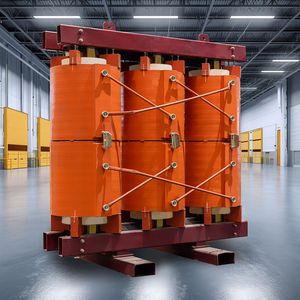
Heavy-duty arc furnace transformers typically employ forced-oil forced-water (OFWF) or forced-oil forced-air (OFAF) cooling systems to quickly remove localized hot-spot heat from high-current secondary bushings and windings. For smaller indoor substations, dry-type cast resin (AN/AF) cooling is preferred for maximum fire safety.
Q:
What role does On-Load Tap Changer (OLTC) technology play in furnace voltage regulation?
Metallurgical processes require precise step-by-step voltage adjustment across different process stages (e.g., initial arc striking, rapid melting, and refining). OLTC units allow automated, seamless ratio switching under full load conditions without interrupting the furnace arc or power supply.
Q:
How is Total Cost of Ownership (TCO) evaluated when comparing transformer exporter bids?
TCO is calculated using the formula: TCO = Purchase Price + (A × No-Load Loss in kW) + (B × Load Loss in kW), where A and B represent capitalized energy cost values per kilowatt over the transformer's expected 25 to 30-year operational lifecycle. Choosing Level 3 low-loss units dramatically lowers long-term utility expense.
Q:
What international export compliance and Factory Acceptance Tests (FAT) are conducted prior to shipping?
Comprehensive FAT protocols include routine testing (winding resistance, voltage ratio, phase displacement, insulation resistance, power frequency withstand, and no-load/load loss measurement) and type testing (temperature rise test, impulse voltage withstand, and short-circuit withstand verification) per IEC 60076 standards.